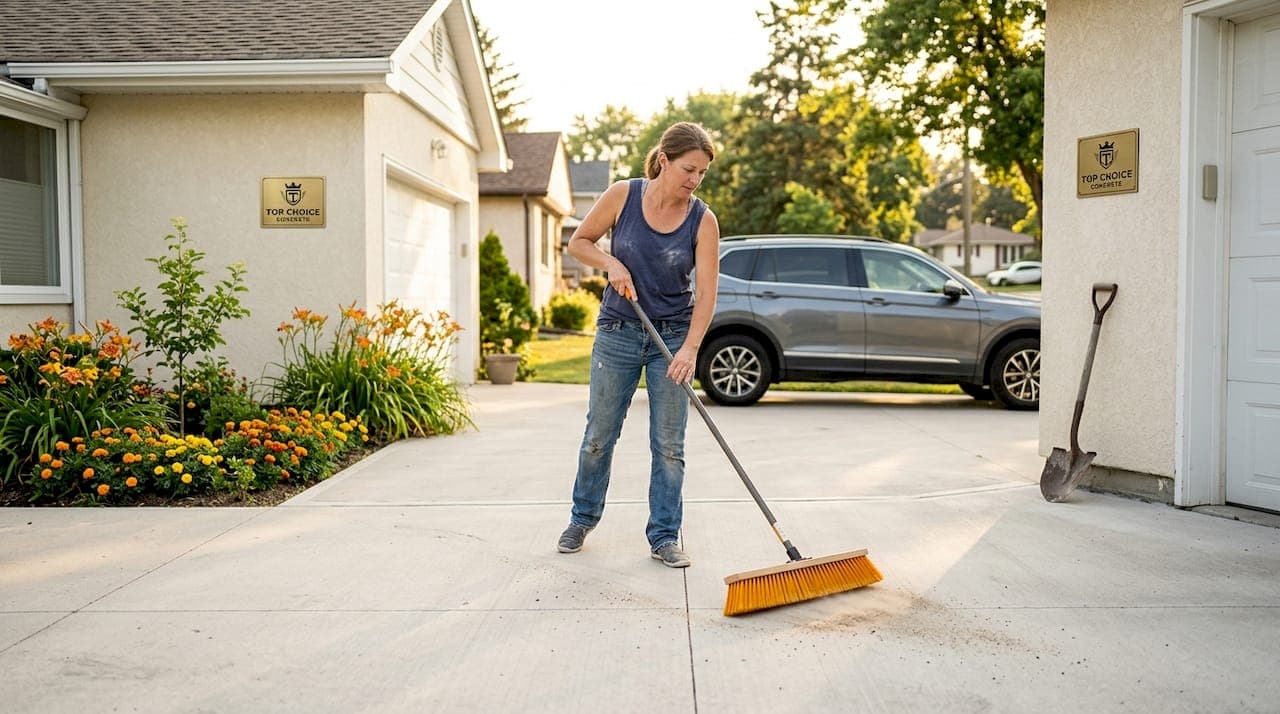
A concrete driveway is one of the hardest-working surfaces on your property, and it takes a beating every single day. Vehicles, weather, spills, and freeze-thaw cycles all chip away at it over time. The good news is that concrete driveways can last 25 to 40 years with the right care. Following practical concrete driveway maintenance tips does not require a contractor on speed dial. It requires a routine, the right products, and knowing what to watch for before small problems become expensive ones.
Table of Contents
- Key takeaways
- 1. Essential concrete driveway maintenance tips for cleaning
- 2. How to handle oil and stain cleanup fast
- 3. Sealing your concrete driveway: timing and types
- 4. Identifying and repairing cracks the right way
- 5. Seasonal maintenance tasks that protect year-round
- 6. Comparing maintenance methods: DIY vs. professional care
- What 20 years of concrete work taught me about driveway care
- Protect your driveway with expert help from Thetopchoiceconcrete
- FAQ
Key takeaways
| Point | Details |
|---|---|
| Seal every 2 to 3 years | Regular sealing protects against moisture, UV damage, and staining to extend driveway life. |
| Clean spills immediately | Oil and fluid spills can penetrate unsealed concrete within hours, especially in hot weather. |
| Use flexible crack fillers | Polyurethane or silicone caulk handles concrete movement better than rigid patching compounds. |
| Avoid salt in winter | Chemical de-icers accelerate surface scaling. Use sand for traction instead. |
| Inspect twice per year | Catching hairline cracks early saves significant money compared to waiting for major damage. |
1. Essential concrete driveway maintenance tips for cleaning
Cleaning is the foundation of all concrete driveway care. Without it, surface contaminants break down the concrete over time and make sealing less effective. The goal is a regular schedule, not a one-time deep clean.
Start with a sweep or leaf blower pass every week or two to remove debris, dirt, and organic matter. Leaves left sitting on concrete can leave tannin stains that are stubborn to remove. For a more thorough clean, use a garden hose with a spray nozzle monthly during heavy-use seasons.
For your annual deep clean, pressure wash at 2,500 to 3,000 PSI using a 25-degree fan tip nozzle. This combination cleans effectively without etching or scarring the surface. Keep the nozzle moving and maintain at least 12 inches of distance from the concrete.
When it comes to cleaning agents, choose products made specifically for concrete. Avoid harsh cleaners like muriatic acid or strong degreasers. These strip the surface and accelerate wear. A slightly alkaline, concrete-specific cleaner does the job without the damage.
Pro Tip: Schedule your annual pressure wash in spring, after the last frost. This clears winter grime and preps the surface perfectly before you evaluate whether resealing is needed.
2. How to handle oil and stain cleanup fast
Oil stains are the number one enemy of a clean concrete driveway. The problem is not just cosmetic. Oil penetrates unsealed concrete within hours when surface temperatures are high, which is a real concern during Alabama summers or any hot climate.
When a spill happens, act immediately. Blot up as much liquid as possible with an absorbent material like cat litter or sawdust. Let it sit for 15 to 20 minutes, then sweep it away. Follow up with a concrete degreaser and a stiff brush. Rinse thoroughly.
For older stains, a poultice made from baking soda and water or a commercial concrete stain remover can draw out residue. Apply it, cover with plastic wrap, and let it work overnight before scrubbing and rinsing. Do not expect miracles on stains that have been sitting for months on unsealed concrete. Prevention and speed are your best tools here.
3. Sealing your concrete driveway: timing and types
Sealing is the single most protective step in maintenance for concrete driveways. A quality sealer creates a barrier against moisture intrusion, UV degradation, and surface staining. Sealing makes routine cleaning easier and adds years to the driveway's life.
There are two main categories of sealers to know:
- Penetrating sealers soak into the concrete and protect from within without changing the surface appearance. They work well for driveways that see heavy traffic or are exposed to freeze-thaw cycles.
- Topical sealers sit on the surface and create a film. They can add a wet or glossy look, which works well for decorative or stamped concrete. They do require more frequent reapplication.
Reseal every 2 to 3 years as a general rule. In hotter climates where surface temperatures can exceed 140°F, the sealer breaks down faster. Check annually by dripping water on the surface. If it absorbs instead of beading, it is time to reseal.
Preparation is where most DIY sealing jobs go wrong. Clean the surface thoroughly and wait at least 48 hours after pressure washing before applying sealer. Moisture trapped under the sealer causes adhesion failure, bubbling, and peeling. Do not rush this step.
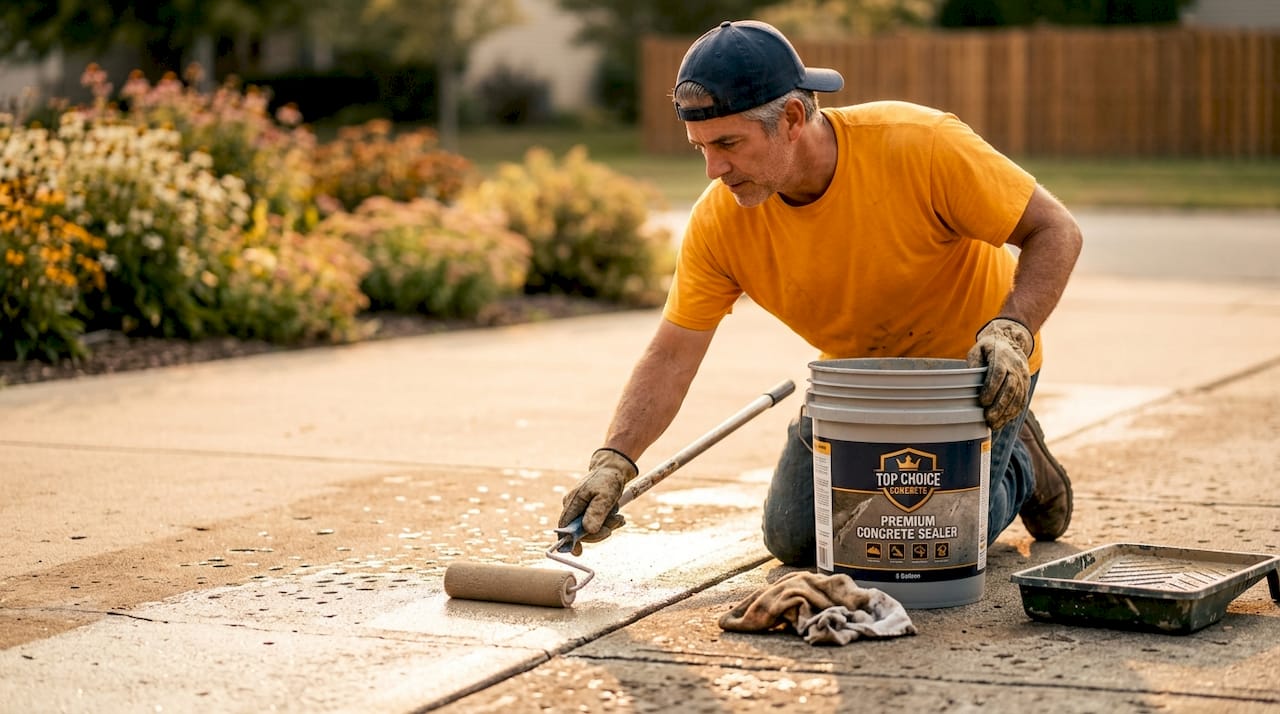
Pro Tip: Apply sealer in two thin coats rather than one thick coat. Thin coats bond better and cure more evenly. Avoid sealing in direct midday sun or when temperatures are above 90°F.
4. Identifying and repairing cracks the right way
Cracks are not just cosmetic problems. Water gets in, expands during freeze cycles, and widens the crack from the inside. Left alone, a hairline crack becomes a structural problem. Inspect your driveway twice per year for early signs of cracking, ideally in spring and fall.
Here is a straightforward process for repairing cracks yourself:
- Clean the crack thoroughly. Use a wire brush or compressed air to remove loose debris, dirt, and old filler material. The crack must be clean for any repair product to bond properly.
- Choose the right filler. Flexible polyurethane or silicone caulk is the right call for most hairline and moderate cracks. These materials flex with the concrete as it expands and contracts. Rigid patching compounds crack again quickly.
- Fill and tool the crack. Apply the filler slightly overfilled, then smooth it flush with the surface using a putty knife or gloved finger. For wider cracks, use a backer rod first to reduce the amount of filler needed and improve the seal.
- Allow full cure time. Do not seal over a crack repair until the filler has fully cured per the manufacturer's instructions. Rushing this step causes the sealer to fail at that spot.
For control joint fillers that have shrunk, cracked, or pulled away from the edges, the same flexible caulk approach applies. Clean out the old material completely before refilling.
Pro Tip: Do crack repairs in fall or spring when temperatures are between 50°F and 80°F. Extreme heat or cold affects how filler cures and bonds, and repairs done in the right conditions last significantly longer.
When cracks are wider than a quarter inch, run in multiple directions, or show vertical displacement, call a professional. Those signs point to a foundation or sub-base issue that surface repair alone will not fix.
5. Seasonal maintenance tasks that protect year-round
Concrete driveway care is not a once-a-year event. Each season brings different stressors, and your maintenance tasks should shift accordingly. Here is how to think about it by season:
Spring is your most important maintenance window. Pressure wash the entire surface, inspect every crack and control joint, and assess whether resealing is needed. This is the best time to do repairs because temperatures are moderate and the concrete is stable.
Summer demands vigilance about spills. Heat accelerates stain penetration, so any oil, sap, or fluid needs to come up fast. Avoid power washing in the peak of midday heat since the rapid temperature change can stress the surface.
Fall offers a second opportunity to seal if you missed spring, and it is your last chance before winter. Clear leaves regularly. Organic debris holds moisture against the concrete and promotes staining and surface degradation.
Winter is where most homeowners make their biggest mistakes. Avoid salt and chemical de-icers entirely on concrete driveways. They accelerate surface scaling and spalling, especially during freeze-thaw cycles. Use sand for traction instead. For snow removal, use a plastic shovel rather than a metal blade that can chip or scratch the surface.
| Season | Primary task | What to avoid |
|---|---|---|
| Spring | Pressure wash, inspect, reseal | Sealing over damp surface |
| Summer | Immediate spill cleanup | Power washing in extreme heat |
| Fall | Leaf removal, secondary seal window | Letting debris sit on surface |
| Winter | Sand for traction, plastic shovel | Salt, chemical de-icers |
6. Comparing maintenance methods: DIY vs. professional care
Not every maintenance task carries the same complexity or risk. Knowing where to draw the line between doing it yourself and calling a pro saves you money and prevents mistakes that cost more to fix.
Routine cleaning, basic stain removal, and resealing a standard broom-finish driveway are well within reach for most homeowners. The tools are widely available, the products are not expensive, and the process is forgiving enough that minor errors do not cause lasting damage.
Where things get more complicated is with decorative and stamped concrete. These surfaces require color-matched sealers and specific application techniques to avoid blotchy or uneven results. Using the wrong topical sealer on stamped concrete can cloud the finish or peel within a season. If your driveway has any decorative treatment, consult a professional before sealing it yourself.
Crack repair is another area where DIY works for minor issues but falls short for anything structural. If you are seeing multiple intersecting cracks, heaving, or sections that have shifted vertically, resurfacing or professional repair is the right path. Resurfacing adds a new layer of concrete over the existing slab and can extend the driveway's life by a decade or more when the base is still sound.
The concrete services at Thetopchoiceconcrete cover the full range from routine maintenance to full resurfacing, which is worth knowing when a repair goes beyond what a tube of caulk can handle.
What 20 years of concrete work taught me about driveway care
I have seen homeowners spend thousands of dollars on repairs that were entirely preventable. And almost every time, the root cause was the same: they waited too long.
The most common mistake I see is treating concrete like it is indestructible. It is not. It is durable, yes, but it needs attention. The homeowners who get 40 years out of a driveway are the ones who sealed it on schedule, cleaned up spills the same day, and caught cracks when they were still hairline thin.
The second mistake is skipping surface prep before sealing. I cannot overstate how often sealer fails because someone applied it to a damp or dirty surface. The sealer looks fine for a few weeks, then starts peeling in sheets. All that work wasted because they did not wait 48 hours after washing.
My honest advice: build a simple two-task annual routine. Pressure wash in spring, inspect every crack, and decide whether to reseal. That one habit, done consistently, handles the majority of what damages a driveway over time. Everything else is reactive. The routine is what keeps you ahead of the repair bills.
— David
Protect your driveway with expert help from Thetopchoiceconcrete
When maintenance tasks go beyond a weekend project, Thetopchoiceconcrete is ready to help. With over 20 years of hands-on concrete experience in Central Alabama, our team handles everything from professional sealing and crack repair to full driveway resurfacing.
We know what Alabama summers and winters do to concrete, and we bring that regional knowledge to every job. Whether you need a one-time repair or want to set up a proper maintenance cycle, our team delivers clean workmanship at fair prices. Explore our driveway and repair services to see what we offer, or check our service coverage area to confirm we work in your neighborhood. Getting a quote is straightforward, and we are known for clear communication from the first call to the final walkthrough.
FAQ
How often should I seal my concrete driveway?
Reseal your concrete driveway every 2 to 3 years. In hot climates where surface temperatures run high, check annually by seeing whether water beads or absorbs into the surface.
What is the best way to clean a concrete driveway?
Sweep or blow off debris regularly and pressure wash annually at 2,500 to 3,000 PSI with a 25-degree nozzle. Use a concrete-specific cleaner and avoid harsh acids or degreasers.
Can I repair driveway cracks myself?
Yes, for hairline and moderate cracks. Clean the crack thoroughly and fill it with flexible polyurethane or silicone caulk. Avoid rigid patching compounds, which crack again as the concrete moves.
What should I avoid putting on concrete in winter?
Avoid salt and chemical de-icers entirely. They cause surface scaling and spalling during freeze-thaw cycles. Use sand for traction and a plastic shovel for snow removal instead.
When should I call a professional for driveway repairs?
Call a professional when cracks are wider than a quarter inch, run in multiple directions, or show any vertical displacement between sections. These signs indicate sub-base issues that surface patching will not resolve.